Engine component penalties and back-of-the-grid starts explained
A grid drop looks like a punishment, yet teams often choose it on purpose.


Few moments in a single-seater weekend feel as dramatic as a driver being told that a power unit change will send them to the back of the grid. To casual viewers it can look like a harsh and slightly mysterious punishment. In reality it is the visible end of a long chain of rules about how many parts a car may use, and teams plan around those rules far more carefully than most fans realise. Understanding how they work makes a grid drop look less like bad luck and more like a calculated choice.
In brief
- To casual viewers it can look like a harsh and slightly mysterious punishment.
- Here is where the back of the grid comes in.
- The answers usually reveal that the grid drop was a plan rather than a punishment.
Why component allowances exist
Modern racing engines are made of several major elements, such as the combustion engine, the turbocharger, the energy recovery systems, the battery and the exhaust. To control costs and keep reliability meaningful, the regulations give every driver a fixed allowance of each element for the whole season. As long as a driver stays within that allowance, nothing happens. The moment a team fits one more than the allowance permits, a penalty is triggered.
The idea is simple. If parts were unlimited, the richest teams could fit a fresh, more powerful unit for every session and treat engines as disposable. A cap forces engineers to build components that last, and it rewards the teams that manage their mileage wisely.
How the penalty is applied
The penalty is not a fine or a loss of points. It is a loss of track position at the start of the race. Fitting an extra element costs a set number of grid places, and larger components cost more than smaller ones. If several elements exceed the allowance at once, the drops are added together.
Here is where the back of the grid comes in. When the total drop is larger than the number of places the driver could actually lose, for example because they qualified near the front and the penalty is heavy, the driver simply starts last. Any places that could not be taken on the grid may be converted into a different sanction, such as a time penalty or a pit lane start, depending on the rules in force. A driver who starts from the pit lane leaves after the field has gone by, which is slightly different from starting last on the grid but similar in effect.
Whether a shorter weekend race is affected also depends on the regulations. In some formats the penalty applies only to the main race, which is why teams sometimes take new parts without worrying too much about that earlier session.
How teams plan the timing
Because the penalty is the same wherever it is taken, the smart question is not whether to take it but where and when. Teams think about several factors:
- Overtaking potential. On a track where passing is easy, a driver starting at the back can recover far more positions than on a narrow street layout where the order barely changes.
- Weather outlook. A wet or chaotic race gives a back-marker more chances to climb through the field, so a forecast of rain can make a penalty cheaper.
- Championship position. A driver with a comfortable points lead can afford a poor weekend, while a rival fighting for every point cannot.
- Part mileage. If an element is already worn and risks failing, replacing it on the team’s own terms is better than suffering a breakdown in the middle of a race.
- Performance updates. A new specification may be ready only at a certain point of the year. Teams often bundle the upgrade with a penalty they were going to take anyway, so that the extra power arrives at no additional cost.
Common misunderstandings
One frequent mistake is to assume that a penalised driver has no chance. Starting at the back with a fresh, powerful unit, a strong car and a good strategy can produce a remarkable recovery, especially when early safety car periods bunch the field. Another is to think that a team has been careless. In many cases the penalty was chosen deliberately because the cost in track position was smaller than the benefit of a fresh element or an upgrade.
It is also worth remembering that a driver in a poor qualifying position has little to lose. If the car is already likely to start deep in the order, taking the penalty that weekend wastes far less than doing so when the car would otherwise start on the front row.
The next time a driver is sent to the back after an engine change, look beyond the headline. Ask how many parts remain in the allowance, how easy the track is for passing, and whether the team needed the upgrade. The answers usually reveal that the grid drop was a plan rather than a punishment.
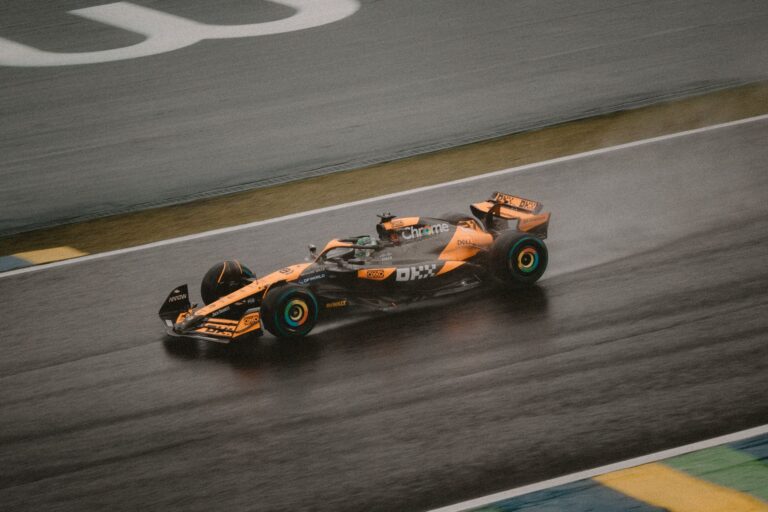
Featured image. Source: Wikimedia Commons. Credit: RFNirmala. License: CC BY 4.0.